
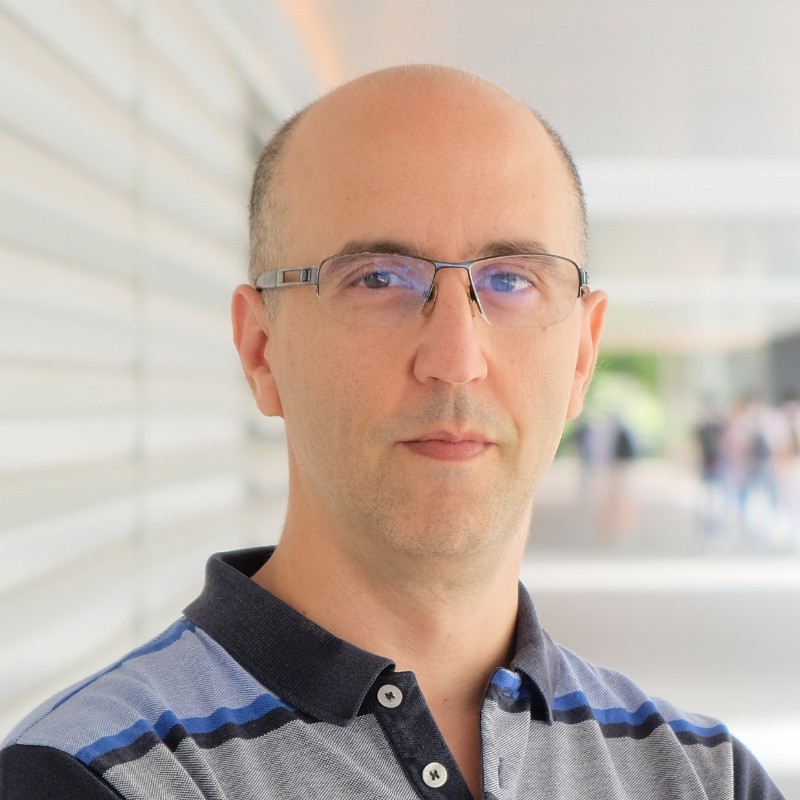
ELLIS Unit Madrid is pleased to announce the upcoming talk “The role of egocentric perception in assistive devices and clinical environments”, organised at the Escuela Politécnica Superior of Universidad Autónoma de Madrid (UAM).
The seminar will be delivered by Rubén Martínez-Cantín, Associate Professor at the University of Zaragoza and co-director of the Robotics, Computer Vision and Artificial Intelligence group at the Instituto de Investigación en Ingeniería de Aragón (I3A).
Recent advances in computer vision are making it possible to extract increasingly rich structural and functional information from first-person viewpoints. In this talk, Prof. Martínez-Cantín will explore the field of egocentric perception, with a focus on two highly relevant application areas: wearable cameras for blind and visually impaired individuals, and real-time 3D reconstruction during endoscopic procedures.
For assistive technologies, the talk will move beyond standard scene understanding to address key challenges such as affordance representation, action anticipation and knowledge transfer. The presented approaches combine self-supervised methods for affordance grounding, Neural Radiance Fields (NeRFs) for semantic knowledge transfer, and Bayesian methods together with attention mechanisms for action anticipation. These techniques allow assistive systems to better understand how humans can interact with their surroundings. The talk will also discuss the use of Bayesian deep learning to quantify predictive uncertainty, a crucial aspect for the safe deployment of task assistance systems.
In the clinical domain, Prof. Martínez-Cantín will present a new SLAM system for online 3D reconstruction of endoscopic images. This system combines classical geometric and optimisation methods with physics-informed deep learning techniques, embedding geometric constraints into neural networks to enable dense 3D reconstruction in clinical environments.
Rubén Martínez-Cantín’s research spans machine learning, computer vision, robotics, assistive technologies and optimisation. Before joining the University of Zaragoza, he worked at SigOpt, a San Francisco-based start-up focused on Bayesian optimisation, acquired by Intel in 2020, as well as at the Centro Universitario de la Defensa in Zaragoza, Instituto Superior Técnico in Lisbon and the University of British Columbia. He received his MSc and PhD in Computer Science and Electrical Engineering from the University of Zaragoza in 2003 and 2008, respectively.
The event will take place on Friday, 19 June 2026, at 10:30, in Sala de Grados A (A-120), Escuela Politécnica Superior, UAM.